.png)

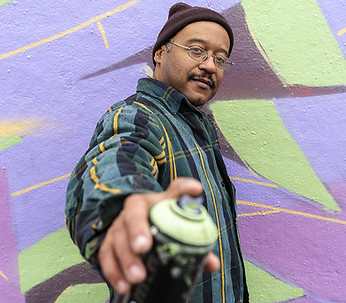
Chicago Hip Hop Heritage Museum founders (l) Brian Gorman, Darrell "Artistic" Roberts and Carrico "Kingdom Rock" Sanders Credit: Jamie Nesbitt Golden/Block Club Chicago
Carrico Kingdom Sanders being Vice President of Chi Rock Nation, a board member of Custom Resources NFP, and a Director at Diverse City had the vision to form the partnership. He brought the idea to Dunbar High school classmate and President of ChiRock Nation Darrell Artistic Roberts and Columbia College classmate and President of Custom Resources and Diverse City Brian Gorman. Together Roberts, Sanders, and Gorman curated decades of photos, flyers, and other memorabilia mostly from their personal collections as well as items loaned to enhance the exhibit. The exhibit was set to be housed in a Bronzeville Greystone occupied by Brian Gorman.
Although originally intended as a one month pop up, the exhibit transformed into what is now the Chicago Hip Hop Heritage Museum. The Chicago Hip Hop Heritage Museum proved its concept over the course of 4.5 years hosting 4 exhibit rotations, and countless hip hop curated themed events. In January 2026, The Chicago Hip Hop Heritage Museum will step away from its 4505 S. Indiana location to prepare for its new home coming 2028, and continue broadening existing and establishing new partnerships.
(Disclaimer, we are not part of the Legends Project as mentioned in the Reader, Block Club Chicago, Time Out Chicago)
The Chicago Hip Hop Heritage Museum celebrates the Hip Hop community that has served as an alternative to negativity by providing creative outlets since the 70s. The Chicago Hip Hop outlet was used to save lives and became therapeutic to the many that participated to escape from the realities of gangs and drugs.
Through the elements of Hip Hop Graf writers like Ray Pitman, Trixster, Slang, Artistic, and Upski were able to channel through visual arts. Emcee/ Rappers like Captain Skyy, Casper, Dr. Groove, DA Smart, IllState Assassins, Twista, Chance the Rapper, and Kanye West were able to channel through performance and music. DJs like 33 1/3, Mustapha Rocks, Timbuktu, World was able to do the same. The museum pays homage to radio personalities like Pink House, Chilly Q, First Lady, Al Greer, and Ramonski Luv and dancers like Jeffery Daniels, Shabba Doo, Brickheadz, King Charles, and Prince Jron.
HISTORY OF CHICAGO HIP HOP HERITAGE MONTH
MEET THE TEAM
Brian Gorman - President
Brian Gorman is a Chicago-based music industry executive, publisher, media producer, and cultural preservationist whose career spans more than three decades at the intersection of Hip Hop, journalism, live production, and institution building. He is the Co-Founder of the Chicago Hip Hop Heritage Museum (CHHHM), an institution dedicated to documenting, preserving, and elevating Chicago’s foundational contributions to global Hip Hop culture.
Gorman’s foundation in the music industry was established in the mid-1990s during Chicago’s underground music renaissance. In 1995, he joined Atom Entertainment and Atom Magazine as an event coordinator and associate publisher, producing live showcases at venues including the Elks Lodge, Riverwest Brewery, the Prop House, and the House of Blues. Atom Magazine became a vital platform chronicling Chicago’s independent movement and featured national artists touring through the city, including Destiny’s Child. From 1999 to 2001, Gorman served as Publisher of Atom Magazine, expanding its editorial vision and solidifying its role as a cultural archive.
He earned a Bachelor of Arts in Music Business Management from Columbia College Chicago in 1999. While serving as Executive Director and Student President of the Music and Entertainment Training Institute (METI), he was Co-Executive Producer of the Sprite All-Star Mixtape and Hip-Hop Unity Fest, overseeing artist coordination, branding strategy, production management, and promotional execution. Artists affiliated with METI went on to win the WGCI Radio Showcase in consecutive years, demonstrating the strength of the development model he helped lead.
In 2000, Gorman founded Diverse City of America Inc., a cultural production and marketing firm supporting artist releases, branding campaigns, and live event execution. From 2001 through 2009, he served as Assistant Main Stage Producer for the Essence Music Festival, coordinating production logistics, sponsor activations, and artist operations on one of the largest stages celebrating Black music and culture.
Media & Journalism Leadership
From 2007 to 2010, Gorman held senior editorial roles at Standard Newspapers, serving as Managing Editor, Art Director, and Lifestyle Editor across Chicago and the South Suburbs. In this capacity, he oversaw editorial direction, layout design, investigative features, and community storytelling initiatives. His leadership strengthened the publication’s cultural coverage and expanded its engagement with music, arts, entrepreneurship, and neighborhood development. This period sharpened his expertise in narrative framing, media operations, and visual storytelling—skills that would later become foundational to museum curation and publishing.
Publishing & Literary Contributions
In 2018, Gorman founded Gorman House Publishing, an independent Chicago-based publishing company focused on cultural documentation, civic thought, and Hip Hop philosophy. Through this platform, he has prioritized works that preserve community narratives and intellectual traditions within Black cultural movements.
Among its notable publications are:
-
The Black Agenda – A work centered on civic engagement, policy awareness, and community empowerment.
-
The Tao of the MC – A philosophical exploration of the mindset, discipline, and spiritual dimensions of emceeing and Hip Hop artistry.
Through Gorman House Publishing, he has also produced Chicago Community Activism Magazine, further reinforcing his commitment to independent media infrastructure and narrative ownership.
Digital Media & Podcast Production
In 2021, Gorman founded Bronzeville Podcast Studio, a media production hub designed to amplify independent voices and preserve contemporary cultural dialogue. The studio has produced and supported multiple programs, including ITZ Podcast (over 130 episodes), Hip Hop Unplugged, and the Chicago Community Activism Podcast. Bronzeville Podcast Studio operates as both a creative space and a documentation engine—capturing stories, interviews, and perspectives that might otherwise go unrecorded.
Institutional Legacy
On July 3, 2021, Gorman co-founded the Chicago Hip Hop Heritage Museum, the culmination of decades spent as a producer, publisher, DJ executive, journalist, and cultural organizer. Through CHHHM, he helps lead archival preservation, exhibit development, cultural tours, oral history initiatives, and educational programming. The museum stands as a permanent institutional home for Chicago Hip Hop’s DJs, emcees, breakers, graffiti writers, promoters, and media figures.
While he also serves as President of the Board of Directors of the TRECC Community Development Foundation, his leadership philosophy remains rooted in cultural infrastructure—building sustainable systems that preserve history while creating pathways for future generations.
Across publishing, journalism, live production, DJ culture, artist development, and museum leadership, Brian Gorman’s work reflects a consistent mission: to preserve legacy, build institutions, control narrative, and position Chicago Hip Hop within its rightful place in global cultural history.
Carrico Sanders - Vice-President
Carrico “C.Kingdom Rock” Sanders is a Chicago-based hip hop historian, cultural preservationist, community organizer, educator, and artist whose life’s work spans more than three decades at the intersection of music, activism, youth development, and cultural documentation. Widely regarded as a foundational figure in Chicago’s hip hop ecosystem, Sanders has dedicated over 38 years to preserving, promoting, and positioning Chicago hip hop as a global cultural force—what he reverently describes as “H.E.R.” (Hip Hop in its Essence is Real), a living institution that extends far beyond music into education, identity, and community empowerment.
Raised in Chicago’s Ida B. Wells community, Sanders’ early exposure to literature, music, and performance laid the groundwork for his artistic and intellectual development. Inspired by reading, rhythm, and early influences such as televised dance culture, spoken word artists, and political thinkers, he developed a deep appreciation for language, expression, and the social power of art. His formative years were shaped by both hardship and mentorship. Participation in programs such as Big Brothers Big Sisters, exposure to civic organizing during Harold Washington’s historic mayoral campaign, and guidance from educators and community leaders instilled in him a lifelong commitment to service, leadership, and social consciousness.
As a teenager, Sanders attended Dunbar Vocational High School, where he focused on business studies while participating in ROTC and the marching band. During this period, he immersed himself fully in hip hop culture, studying dance, DJing, and lyricism while building citywide connections. In 1985, he co-founded the USA Crew, later known as the Technical Def Fresh Crew (TDFC), and became a recognized freestyle and battle emcee throughout Chicago. That same year, he founded Rocking All Nation (RAN Nation), a multi-element collective of rappers, DJs, graffiti writers, dancers, and beatboxers from Ida B. Wells. The group gained a strong reputation across the city’s underground scene, competing with and defeating rival crews while helping establish Chicago’s early hip hop identity.
Sanders’ leadership extended beyond performance. He organized the All Element All City Hip Hop Meetings at the Iowa Building—known affectionately as the “Terror Dome”—which became a foundational gathering space for Chicago’s hip hop pioneers. He later co-founded the legendary Empire of Destruction (E.O.D.), contributed to the No Pity Committee, and eventually created his final crew, the Ill State Assassins. In 1987, he was selected by Bill West as Vice President of the Midwest Hip Hop Movement, where he helped build a regional network supporting independent artists and expanding opportunities across the Midwest.
Parallel to his artistic development, Sanders became deeply involved in social justice organizing under the mentorship of Dr. Finley Campbell of the Committee Against Racism (InCAR). Through InCAR, he learned to organize, mobilize, and educate communities, participating in protests, community actions, and public demonstrations that contributed to the integration and transformation of spaces like Marquette Park. These experiences helped shape his understanding of hip hop as both cultural expression and social movement.
After graduating high school, Sanders founded Kingdom Rock Productions, an artist development and management company. His event organizing and promotional work quickly gained recognition; in 1991, The Source Magazine’s Regional Report highlighted Kingdom Rock Productions as Chicago’s leading underground party promoters. He later restructured the organization into the Ill(inois) State Assassins, where he managed bookings, promotions, and road operations while assisting in the creation of independent labels including Coroner Records, Creator Way Associated Labels (CWAL), and Wicked Entertainment Group. The collective played a significant role in Chicago’s underground dominance through the late 1980s and 1990s, supporting artists and producers who would later achieve national success.
In 1992, becoming a father shifted Sanders’ priorities and expanded his commitment to community building. He continued to promote hip hop culture while working multiple jobs, volunteering in churches and civic organizations, and advocating for youth. In 1994, he was awarded “Best Promoter in Chicago” at the inaugural Props Awards. He also served two years as a Volunteer in Service to America (VISTA) Task Force Organizer with the Chicago Alliance for Neighbor Safety (CANS), working alongside the ACLU and community partners to challenge the Anti-Gang Loitering Law, a case that reached the U.S. Supreme Court. Through CANS, Sanders helped produce “The Whatz Up Show,” a weekly public access television program that became a staple of Chicago cable from the 1990s into the early 2000s; he later served as a regular host from 1999 to 2001.
Sanders enrolled at Columbia College Chicago in 2000 and earned a Bachelor of Arts in 2003 with a concentration in Artist Entertainment Media Management and Marketing. During this time, he also obtained certification in early childhood behavior and studied early childhood development through the City Colleges of Chicago, strengthening his ability to work with youth and families.
Throughout the 2000s and 2010s, Sanders continued to perform, record, and mentor. He appeared on projects with fellow Ill State Assassins members, contributed to releases connected to Chicago’s underground movement, and in 2015 released his first solo project, Under RICOnstruction. In 2016, he joined the Legends of Chicago Hip Hop collective for the Stop the Violence mixtape and participated in community programming with Rage for Greater Englewood (R.A.G.E.), performing in neighborhood parks while promoting youth services, food access awareness, and positive cultural engagement.
In 2017, Sanders was appointed Vice President of Chi R.O.C.K. Nation (Respect Our Creative Kings/Kids), Chicago’s historic multi-element hip hop organization. Through this role, he supported community drives, youth initiatives, and cultural preservation efforts, including back-to-school events, food pantries, coat and toy distributions, and holiday meal programs.
In July 2021, Sanders helped transform a Bronzeville greystone into what became the Chicago Hip Hop Heritage Museum, expanding from a temporary exhibition celebrating the 18th anniversary of Chicago Hip Hop Heritage Month into a permanent cultural hub. For several years, the museum curated exhibitions, hosted tours, produced podcasts, screened films, and provided a gathering space for weddings, fashion shows, and creative projects. Built on the principle of “making something out of nothing,” the museum served as a living archive honoring the pioneers, present contributors, and future voices of Chicago hip hop. Though the original location closed in December 2025 due to the property owner’s retirement, Sanders continues to lead the institution’s next chapter through partnerships, pop-up programming, and a planned 5,000-square-foot facility currently in development.
Among current collaborations is On The Record: A Legacy of Hip Hop, a multimedia installation created with Columbia College Chicago’s Hip Hop Studies program, highlighting the cultural impact of the college’s hip hop community. Additional partnerships include work with the University of Illinois Chicago on the Chicago Hip Hop Digital Archive and Chicago Hip Hop Project.
Across four decades, Carrico “C.Kingdom Rock” Sanders has remained a consistent force in documenting, organizing, teaching, and building infrastructure for hip hop culture. His work reflects a lifelong commitment to ensuring that the stories, contributions, and lived experiences of Chicago’s hip hop pioneers are preserved, honored, and passed on to future generations.
Darrell Roberts - Vice-President
Darrell “Artistic” Roberts is a pioneering Chicago Hip Hop artist, cultural educator, and community advocate whose work has helped shape and preserve the city’s Hip Hop legacy for over four decades. Born on August 1, 1970, and raised in Chicago, Roberts represents the powerful cultural lineage of neighborhoods such as Roseland, Rosemoor, and Bronzeville—communities that deeply influenced his artistic voice and commitment to cultural preservation.
Active in Hip Hop since 1982, Roberts emerged during the global explosion of Breaking culture in the early 1980s. Initially inspired by street dance and the vibrant visual and sonic landscape of the era—including radio, magazines, books, television, and the streets themselves—he quickly developed into a multifaceted contributor to the culture. While he participates across all elements of Hip Hop—including emceeing, DJing, media, activism, education, fashion, and visual arts—his primary identity is rooted in B-Boy culture and graffiti writing.
Roberts’ creative philosophy centers on intentional artistry and meaningful expression. He approaches Hip Hop as an interconnected system—“like loose puzzle pieces interlocking together to create a picture.” For him, style is essential, creativity is foundational, and cultural integrity is non-negotiable. His work reflects a dedication to ensuring that Hip Hop remains vibrant, educational, and socially impactful.
Through the Chi-Rock Nation organization, Roberts has played a key role in developing programming, events, and platforms that elevate Chicago artists. From 1993 to 1998, he published Chicago Rocks Magazine, a groundbreaking publication that documented and validated Chicago’s Hip Hop community at a time when few local media outlets did. The magazine planted seeds of legacy for countless artists, encouraging them to recognize the value of their contributions.
Roberts’ artistic achievements span multiple decades. He was featured in the Chicago Sun-Times in 1988 for his graffiti work and won the overall grand award in the 1989 Newhouse Architecture Competition for his graffiti rendering of 123 N. Wacker Drive, along with first place and honorable mentions in additional divisions. He received honorable mention in the 1994 CTA Graffiti Competition, won Best Graffiti Crew at the 1994 Props Awards, placed third in the 2007 Ravinia Poster Contest, and participated in the 2016 City Hall business workshops for entrepreneurs. His work has been featured in numerous publications, podcasts, and media platforms.
Today, Roberts continues his cultural stewardship through his work with the Chicago Hip Hop Heritage Museum, where he helps archive, preserve, and educate communities about Chicago’s Hip Hop history. He views this work as both urgent and essential—ensuring that Chicago’s contributions receive the recognition and respect they deserve.
Deeply committed to youth engagement, Roberts believes Hip Hop represents the “fresh blood” of young people and sees mentorship and education as central to sustaining the culture’s future. His guiding philosophy—“Plan your work and work your plan”—reflects the discipline and vision that have defined his career.
For Roberts, Chicago Hip Hop means everything. He believes the city’s time for full recognition is now and remains steadfast in his mission to amplify its legacy. His goal is to leave behind a creative, impactful, and motivating legacy—one remembered with respect and pride.